Imelda knew everything about martial law; Imee was no baby -Ramos

d13

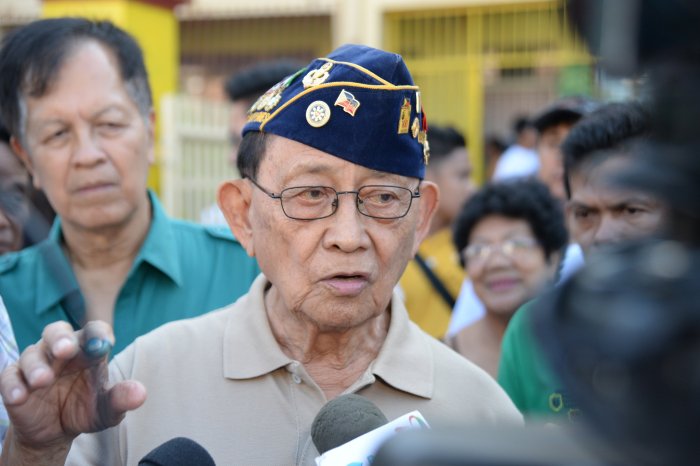
Former President Fidel Ramos on Monday criticized the family of deposed tyrant Ferdinand Marcos for playing innocent and refusing to apologize for the atrocities committed during the regime.

Ramos was reacting to the remark of the late dictator’s eldest daughter, Ilocos Norte Gov. Imee Marcos, who chided Ramos for the abuses during the martial law era and said she was “too young” at the time to make a legal admission of guilt.

Ramos served as chief of the Philippine Constabulary, predecessor of the Philippine National Police, who helped Marcos plan the martial rule. But in a press conference on Feb. 22, 1986, Ramos and then defense minister Juan Ponce Enrile announced their break from the dictator.
“That’s a funny story. When she (Imee) said that they were still young, in fact she said ‘maliliit pa kami ng mga bata’ in Tagalog, I know how old she is because she is one year older than my eldest daughter,” Ramos said at a press conference in his office in Makati City.

“Within a few years after the proclamation of the martial law, Imee was elected, in quotes, ‘president of the Kabataang Barangay.’ So was she a little baby or a little musmusin? Of course not. She was a responsible person,” Ramos told reporters.

Ramos said the Marcos matriarch Ilocos Norte Rep. Imelda Marcos should make the apology on the family’s behalf, noting that the former first lady “knew everything” about martial law, including the assassination of Marcos’ political nemesis, former Sen. Benigno Aquino Jr.

“But in terms of the apology that I requested, it was from the mother, the head of the family, who knew everything, including the beginning of martial law, the good years before martial law, including what must have happened in August 1983,” he said.

Reacting to Imee’s comment, Ramos said the role he played in the historic 1986 Edsa People Power revolt that toppled the dictatorship was his atonement and “more than an apology” for his sins.

“I hope you people will remember your history. My apology was more than an apology. In the Christian tradition, you confess and then you atone. My atonement was leading the military and the police during the Edsa People Power Revolution from the 22nd to 25th of February in 1986. I stand by that record. It’s there in the history books,” the former President said.

“Our atonement at that time was we were ready to die—sacrificing life, family, and future. We laid it on the altar of our nationhood, and said take it away, because what were the odds? Marcos was the overwhelming force. They had the weapons, the chain of command, chief of staff of the Armed Forces under him. And so that was our atonement. Patay kung patay,” he added.

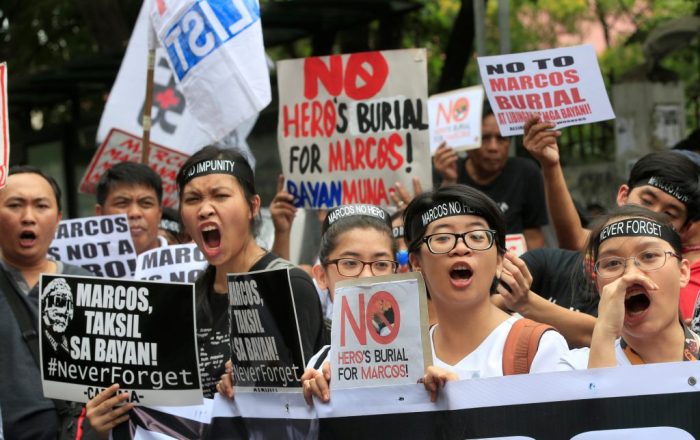
The Marcos patriarch was buried at the Libingan ng mga Bayani last Friday in a secrecy-shrouded ceremony that sparked protests in various parts of the country. Earlier this month, the Supreme Court junked all petitions against President Rodrigo Duterte’s directive to bury Marcos at the heroes’ cemetery as part of his campaign promise, despite strong opposition from martial law victims, rights advocates and the general public.

Marcos’ burial at the LNMB, which saw full military honors including a 21-gun salute, came 30 years after he was toppled in the historic and military-backed Edsa People Power Revolution that ended his two-decade regime, which was marred by human rights abuses and corruption./rga

Read more: http://newsinfo.inquirer.net/846430/ramos-imelda-knew-everything-about-martial-law-imee-was-no-baby#ixzz4Qe1zWy00
Follow us: @inquirerdotnet on Twitter | inquirerdotnet on Facebook
Experts: A Donald Trump Trade War With China Would Hurt America

d11

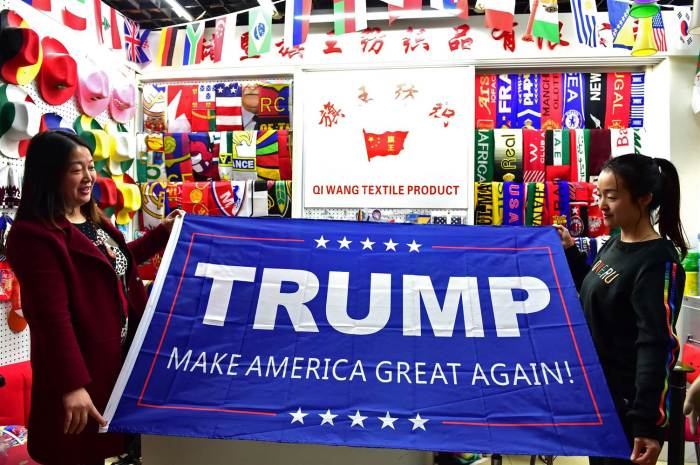
BEIJING — If Donald Trump launches a trade war with China it would likely result in catastrophic losses for both nations and possibly a humbling defeat for the United States, experts have warned.

Trump’s campaign promise to “make America great again” included a threat to slap a 45-percent import tariff on Chinese goods.

“We can’t continue to allow China to rape our country,” he told a rally in Indiana in May. “That’s what they’re doing. It’s the greatest theft in the history of the world.”

But as in a regular war, China has formidable weapons of its own.

The Global Times, a Chinese state-run newspaper, warned last week that Beijing would take a “tit-for-tat approach” if Trump followed through on his bold rhetoric.

“A batch of Boeing orders will be replaced by Airbus, U.S. auto and iPhone sales in China will suffer a setback, and U.S. soybean and maize imports will be halted,” the paper said. “China can also limit the number of Chinese students studying in the U.S.”

That would pose a serious problem for the American economy, whose bilateral trade with China stood at almost $600 million last year.

China will become the world’s first trillion-dollar aviation market over the next two decades with a demand of some 6,810 new airplanes, according to Boeing. China switching to Europe’s Airbus to fulfill this demand would give the U.S. a daunting counterpunch.

The threat to halt soybean and maize imports are similarly intimidating, jeopardizing U.S. food exports to China that are expected to hit $21.5 billion in 2017.

And some 320,000 Chinese students accounted for 31.5 percent of international enrollments in the U.S. last year — a market worth $30.5 billion to the American economy — according to the Institute for International Education.

“If the U.S. levels punitive tariffs on Chinese goods then, in a worst-case scenario, China can retaliate by leveling similar tariff on U.S. goods,” explained Victor Gao, a Chinese international affairs expert who worked as a translator for late Chinese leader Deng Xiaoping. “That will create a vicious cycle and everyone will be a loser.”

Many American giants such as Apple, GM and Ford rely on China both for the manufacture of goods at low prices and as a huge consumer market.

The likely outcome of disrupting this symbiosis? Higher prices hitting the wallets of blue-collar Americans.

Trump’s campaign was built in part on a promise to return industrial jobs to areas such as the Rust Belt. But whatever economic penalties China might pay in a trade war, there would not likely be a direct benefit for the U.S., experts believe.

Apple might be compelled to move its export manufacturing base from the Chinese city of Shenzhen to another place such as Vietnam, while a shoe company like Nike could move to somewhere like Indonesia. Even if some vacancies did trickle back to the States, most would probably be filled by robots.

Not everyone predicts even losses, with some suggesting China might actually welcome such a war.

Tang Xiaoyang, deputy director of the Carnegie-Tsinghua Center for Global Policy, thinks China might benefit from the U.S. tearing up international trade agreements.

“A trade war would cause confusion and complication for the global economy but in the long term it would not hurt China, it would rather hurt the country that launched it, the United States,” he said. “China is already strong enough to resist such a trade war.”

Tang said the China that Trump has been bashing no longer exists. It’s no longer focused on cheap labor that earned it the nickname “the workshop of the world.” Rather, it’s now concentrating on manufacturing its own products to compete with imports from the U.S. and elsewhere.

In May, China unveiled a grand industrial strategy “Made in China 2025,”including plans to grow its own brands in areas such as computing equipment, robotics and the aerospace industry.

“Trump sounds like he’s attacking the China of five years ago,” Tang said. “iPhones, movies, cars — these things China is able to make itself but with less well-known brands. A trade war might even benefit its own brands and its own products.”

Other experts say Trump’s allegation that China is a currency manipulator is also outdated. The U.S. and others have previously alleged that Beijing suppressed the value of the yuan so its exports would be cheaper.

“In fact, the evidence is that they have been propping up their currency, for all sorts of different reasons,” according to William J. Antholis, CEO of the Miller Center, a nonpartisan affiliate of the University of Virginia.

The threat of a tariff could also be moot because Trump would likely require congressional approval for imposing such a high levy on a permanent basis.

“It’s not the kind of thing he could do by administrative fiat,” Antholis said. “And this is the exact kind of thing that a Republican congress that is pro-trade would have a hard time following through with.”

Instead, the threat of high tariffs might be used as a ploy to try to stop China stealing U.S. intellectual property. This practice — of which China is the world’s largest perpetrator — costs the American economy $300 billion a year, according to a 2013 bipartisan commission report.

“Tariffs will be used not as an end game but rather as a negotiating tool to encourage our trading partners to cease cheating,” according to a white paperwritten by Trump’s senior policy advisor Peter Navarro. “If, however, the cheating does not stop, Trump will impose appropriate defensive tariffs to level the playing field.”

Just as Europe is hoping that Trump doesn’t follow through on his campaign rhetoric surrounding NATO, Chinese officials are publicly saying they hope Trump’s bark is worse than his bite.

“Keep in mind that campaign commentary is not government policy,” said James Zimmerman, chairman of the American Chamber of Commerce in China. “Indeed, the president-elect will get absolutely nothing done and create much uncertainty if he carries through with his campaign rhetoric on trade and China.”


Source: http://www.nbcnews.com/

Taiwan and Philippines undertake joint telecoms fraud raid in Cebu


d10

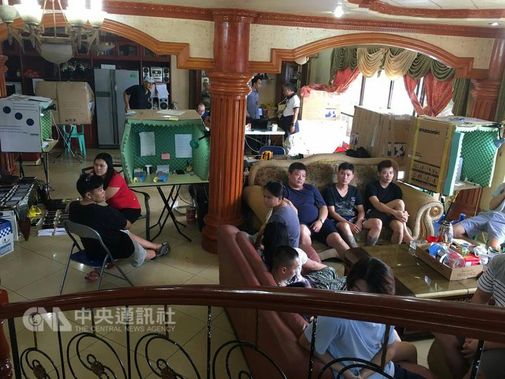
Manila, Nov. 21 (CNA) Law enforcement officials from Taiwan and the Philippines raided a telecoms fraud operation base in Cebu, the second largest city in the Philippines on Monday, arresting 24 suspects, including 19 Taiwanese nationals.

The Taiwanese nationals, 17 men and two women, as well as five Chinese were arrested by the Philippine authorities.

Acting on information provided by Taiwan’s Criminal Investigation Bureau, the National Bureau of Investigation of the Philippines raided the base of operations, seizing telecom equipment and handbooks on how to conduct telecoms fraud.

Filipino agents are checking the identities of the suspects as well as evidence collected at the location.

(By Emerson Lim and Lilian Wu)
Enditem/AW


Source: http://focustaiwan.tw/

Supreme Court asked to order exhumation of Marcos’ remains

d8

MANILA – Opposition lawmaker and Albay Representative Edcel Lagman urged the Supreme Court (SC) to order the exhumation of the remains of former President Ferdinand Marcos, three days after Marcos was interred at the Libingan ng mga Bayani (LNMB).

In an 8-page pleading filed with the high court before lunchtime on Monday, Lagman said the exhumation of Marcos’ remains was necessary since his burial was “premature, precipitate and irregular” on the basis that the decision allowing the burial “has not attained finality and was not executory.”

On November 8, the high court, voting 9-5, with one abstention, junked seven petitions assailing the move of President Duterte to allow Marcos’ interment at the LNMB. The ruling also ordered the lifting of a status quo ante order (SQAO) earlier issued that halted the burial for some two months.

“Since the object of the premature burial is the so-called interred ‘mortal remains’ of Marcos, perforce the same must be exhumed as a rectification of the void execution.

“The exhumation is imperative in order not to render moot and academic the petitioners’ forthcoming and seasonable motion/s for reconsideration, the resolution of which had been preempted by the precipitate burial in the wake of nationwide protests and cogent commentaries against the subject Decision of the [SC],” Lagman’s motion read.

The exhumation is also intended to “effectively censure and discipline” the Marcos family and top defense and military officials for their “disrespect” against the SC, the motion stressed.

The motion further pointed out that “with the inordinate haste and stealthy circumstances which shrouded the interment, there is no certainty as to what was actually buried in the LNMB.”

As such, Lagman asked that a forensic examination of the buried remains be conducted to determine whether what was actually interred were Marcos’ remains, and “not any other artifact or a wax replica of the late dictator, since his remains could have been buried decades ago in Batac, Ilocos Norte as he reportedly wished to be buried near his mother, the late Doña Josefa Edralin Marcos in Batac.”

Lagman also informed the high court that he will also be filing a pleading to cite respondents in contempt of court.

Another group of petitioners, led by former Bayan Muna Representative Saturnino Ocampo, filed a separate petition with the SC, also on Monday, to cite respondents in indirect contempt.


Source: http://news.abs-cbn.com/news

Duterte on Putin: We became ‘fast friends’

d2

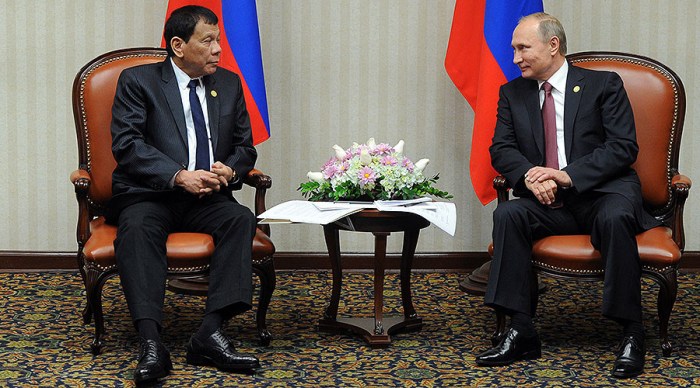
LIMA, Peru — He just met his “idol” here last Saturday but President Rodrigo Duterte already considers Russia President Vladimir Putin and himself as “fast friends.”
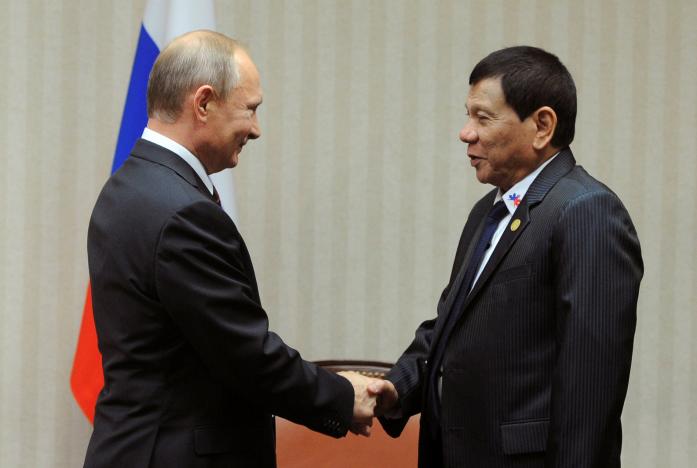
Still delighted by his bilateral meeting with Putin, Duterte narrated to reporters Monday how the often poker-faced Russian leader smiled in his presence and repeatedly invited him to Russia.
“You know, we have become fast friends, President Putin and (China) President Xi Jinping,” Duterte said.
Duterte had a bilateral meeting with Xi on Sunday (Manila time) before his engagement with Putin.
Russian President Putin and Philippine President Duterte attend meeting on sidelines of APEC Summit in Lima
“His (Putin) smile was wide. According to news reports, he does not laugh. But he was smiling all along. He said ‘do not forget to visit Russia. I reserved something for you there.’ ‘True?’ ‘Gun.’ He loves guns,” Duterte said, adding that the Russian president is fond of hunting. “It seemed like we’ve known each other for so long and even the way we pat each other’s hand in a handshake. And you know, I didn’t realize then… before we were seated.”
Duterte said he and Putin were seated beside each other in one of the APEC sessions.
“I was talking with the, I think, the Premier of Vietnam. They were thanking me for the sailors that we sent home. We talked and when I finally sat down, I found out that President Putin was on my left side, so we shook hands,” Duterte said.
“And then after that, I shook his hands again and I finally said I’ll go ahead. Then he gestured to me ‘don’t forget to visit Russia,’” he added.
“He has extended the gracious invitation maybe about four times already. And maybe I will go… I shall go someday.”
During his bilateral meeting with Putin, Duterte assailed western countries, including the United States, for allegedly bullying smaller nations. He also told Putin that the US had forced its allies to join its wars.
Journalists who covered the event were not able to hear Putin’s response as they were already asked to leave the venue while Duterte was talking. Presidential Communications Secretary Martin Andanar said Duterte merely explained to Putin the context and the reasons behind his tirades against the West.


Asked how Putin responded to Duterte’s statements, national security adviser Hermogenes Esperon Jr., who was present during the meeting, said: “Generally, what President Putin said is that we share your sentiments…”

 “He said ‘our assessments coincide in many respects,’” he added without elaborating.
Trade Secretary Ramon Lopez, who was also in the meeting, said Putin lauded Duterte’s firmness.
“Something was said about his being firm, perhaps in a way, he would no longer be bullied, something like that,” Lopez said.
Asked if the president was happy that he finally met Putin, Esperon replied: “We were also happy.”
Source: http://www.philstar.com/