Game preview, picks: Packers at Washington


Teams: Green Bay Packers (4-5) vs. Washington Redskins (5-3-1)

When: 7:30 p.m. Sunday.

Where: FedEx Field.

Television: NBC.                                                                        d12
Radio: AM-620.

Series: Packers lead, 20-14-1.

Line: Redskins by 3.

Weather: 40s and windy.

Surface: Grass.

Coaches: Green Bay’s Mike McCarthy (116-67-1) vs. Washington’s Jay Gruden (18-23-1).

FIVE THINGS TO WATCH

ON THE OUTSIDE: When the teams last met in the NFC wild-card playoffs, Bryan Bulaga limited OLB Ryan Kerrigan to one pressure. Kerrigan, a leverage-power rusher, was neutralized. One personnel man ranked the Redskins’ pass rushers as Preston Smith first, Kerrigan second and Trent Murphy third. “They have three guys that can rush,” another scout said. “None of those guys are flame-throwing guys that scare the (expletive) out of you.” Smith beat JC Tretter, who was forced to play the entire game at left tackle for the injured David Bakhtiari, for a sack-safety in the first quarter. “Smith rushes the passer extremely well,” one scout said. “More athlete. He’s fast and strong enough. Kerrigan is up the field. High, high motor to find a way to get to the quarterback. Murphy has a wide array of moves. His biggest asset is his ability to stay after it. Similar to Clay Matthews. He plays throughout the whole down.”


THIN AGAIN: The Redskins played without three of their top six defensive backs in the playoff game. They’ll play this one without starting safeties David Bruton and DeAngelo Hall, both of whom are on injured reserve. “Down the middle they’re weak,” one scout said. “They don’t have a nose who can hold the point. Their two inside linebackers are very average and their safeties aren’t very good. They’re downhill, try-and-hit-you guys. They’re not real good in the secondary overall. The Vikings picked them apart. (Josh) Norman is a good corner but other than that they have a hard time matching up. Their offense is better than their defense. The offensive coordinator (Sean McVay) does a pretty good job keeping you off balance. He calls a pretty good game.”

DUAL THREATS: In the playoff game TE Jordan Reed had receptions for 24, 22 and 20 yards. In the seven games that Reed has played this season, he has averaged 58.4 snaps and backup Vernon Davis has averaged 31.6. “Reed is a really good receiving tight end but he can also block, too,” nickel back Micah Hyde said. “Their tight ends are playing lights out.” LB Jayrone Elliott said Davis has better straight-line speed than Reed, but he gave the edge in run-after-the-catch ability to Reed. “You saw Davis’ wheel routes,” Elliott said. “He runs three verticals. That’s guy’s amazing. Both of them are amazing. Looks like (Davis) has had a resurgence in his career. He’s a freak. He’s playing great ball right now.”

PASS RUSH: Nick Perry had four pressures in just 26 snaps, leading a pass rush that was outstanding in the playoff game. Julius Peppers did much of his damage against the Redskins’ interior from an inside berth in dime. In the second half, he detonated hump moves against LT Trent Williams half a dozen times and almost got home twice. It might have been his best game of the year. With Williams serving a four-game suspension, the Redskins will turn to Ty Nsekhe at left tackle for a second straight week. He held up surprising well against Minnesota’s Everson Griffen last Sunday. “They didn’t lose much with him in the game,” an NFC scout said. “He’s big, long, moves his feet OK. Pretty grooved with his angles. He ties you up in the run game, and he’s tough. He’ll try to fight you.”

NEW RUNNER: Neither of the Redskins’ two ball carriers in the playoff game, Alfred Morris nor Pierre Thomas, is still with the team. Matt Jones, who sat out with a hip injury, reclaimed his job this season only to be replaced in Game 8-9 by rookie Robert Kelley, a free agent from Tulane. “I don’t know what the deal with him was in college,” said one personnel director. “We had a free-agent grade on him. We missed him. He’s a good back. He runs hard, he’s got good feet and vision. The Vikings couldn’t tackle him. Kelley is really aggressive. He’s downhill. He breaks tackles.” Another scout pointed out that Kelley runs more effectively the more carries he gets.

VIEWS OF THE GAME

BOB McGINN

Ten months ago the Packers beat the Redskins by 17 points on the same field. Great coaches, great quarterbacks and great organizations come together to win games just like this. With a victory, the entire outlook for their season and playoff chances would change. No reason they can’t win.


TOM SILVERSTEIN

As easy as it would be to assume the Packers are going to continue spiraling out of control and implode again, I’m thinking the bleeding stops for one night here. The return of Clay Matthews and availability of Jared Cook, James Starks and David Bakhtiari are enough to give the Packers a chance. This could come down to a Mason Crosby field goal.  Packers 27, Washington 24

MICHAEL COHEN

Let’s make this simple: Washington is better now than it was in a playoff loss to the Packers last season. And there’s no question the Packers are a worse team than the one that traveled to our nation’s capital for an impressive win last January. I don’t see the Packers getting it done for a second time.  Washington 33, Packers 24

PETE DOUGHERTY

Maybe the Packers’ defense bounces back this week, assuming Clay Matthews returns from a hamstring injury. But Washington has a lot more weapons in the passing game (Jordan Reed, Vernon Davis, DeSean Jackson if healthy, Jamison Crowder, Pierre Garcon) than the Packers, and that could be the difference.  Washington 28, Packers 24

RYAN WOOD

A week after Delanie Walker torched them, the Packers have to worry about a pair of tight ends in Washington. The Packers should get Clay Matthews and Jared Cook back, but no amount of reinforcements will change this fact: Jordan Reed and Vernon Davis will be tough covers.  Washington 27, Packers 21


Source: http://www.jsonline.com/
Experts: A Donald Trump Trade War With China Would Hurt America

d11

BEIJING — If Donald Trump launches a trade war with China it would likely result in catastrophic losses for both nations and possibly a humbling defeat for the United States, experts have warned.

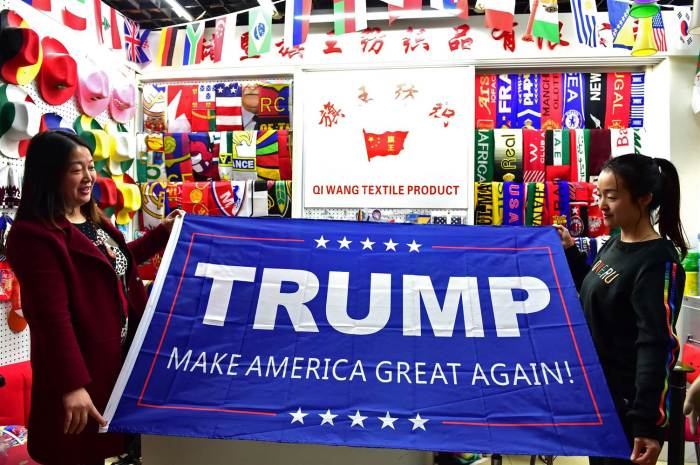
Trump’s campaign promise to “make America great again” included a threat to slap a 45-percent import tariff on Chinese goods.

“We can’t continue to allow China to rape our country,” he told a rally in Indiana in May. “That’s what they’re doing. It’s the greatest theft in the history of the world.”

But as in a regular war, China has formidable weapons of its own.

The Global Times, a Chinese state-run newspaper, warned last week that Beijing would take a “tit-for-tat approach” if Trump followed through on his bold rhetoric.

“A batch of Boeing orders will be replaced by Airbus, U.S. auto and iPhone sales in China will suffer a setback, and U.S. soybean and maize imports will be halted,” the paper said. “China can also limit the number of Chinese students studying in the U.S.”

That would pose a serious problem for the American economy, whose bilateral trade with China stood at almost $600 million last year.

China will become the world’s first trillion-dollar aviation market over the next two decades with a demand of some 6,810 new airplanes, according to Boeing. China switching to Europe’s Airbus to fulfill this demand would give the U.S. a daunting counterpunch.

The threat to halt soybean and maize imports are similarly intimidating, jeopardizing U.S. food exports to China that are expected to hit $21.5 billion in 2017.

And some 320,000 Chinese students accounted for 31.5 percent of international enrollments in the U.S. last year — a market worth $30.5 billion to the American economy — according to the Institute for International Education.

“If the U.S. levels punitive tariffs on Chinese goods then, in a worst-case scenario, China can retaliate by leveling similar tariff on U.S. goods,” explained Victor Gao, a Chinese international affairs expert who worked as a translator for late Chinese leader Deng Xiaoping. “That will create a vicious cycle and everyone will be a loser.”

Many American giants such as Apple, GM and Ford rely on China both for the manufacture of goods at low prices and as a huge consumer market.

The likely outcome of disrupting this symbiosis? Higher prices hitting the wallets of blue-collar Americans.

Trump’s campaign was built in part on a promise to return industrial jobs to areas such as the Rust Belt. But whatever economic penalties China might pay in a trade war, there would not likely be a direct benefit for the U.S., experts believe.

Apple might be compelled to move its export manufacturing base from the Chinese city of Shenzhen to another place such as Vietnam, while a shoe company like Nike could move to somewhere like Indonesia. Even if some vacancies did trickle back to the States, most would probably be filled by robots.

Not everyone predicts even losses, with some suggesting China might actually welcome such a war.

Tang Xiaoyang, deputy director of the Carnegie-Tsinghua Center for Global Policy, thinks China might benefit from the U.S. tearing up international trade agreements.

“A trade war would cause confusion and complication for the global economy but in the long term it would not hurt China, it would rather hurt the country that launched it, the United States,” he said. “China is already strong enough to resist such a trade war.”

Tang said the China that Trump has been bashing no longer exists. It’s no longer focused on cheap labor that earned it the nickname “the workshop of the world.” Rather, it’s now concentrating on manufacturing its own products to compete with imports from the U.S. and elsewhere.

In May, China unveiled a grand industrial strategy “Made in China 2025,”including plans to grow its own brands in areas such as computing equipment, robotics and the aerospace industry.

“Trump sounds like he’s attacking the China of five years ago,” Tang said. “iPhones, movies, cars — these things China is able to make itself but with less well-known brands. A trade war might even benefit its own brands and its own products.”

Other experts say Trump’s allegation that China is a currency manipulator is also outdated. The U.S. and others have previously alleged that Beijing suppressed the value of the yuan so its exports would be cheaper.

“In fact, the evidence is that they have been propping up their currency, for all sorts of different reasons,” according to William J. Antholis, CEO of the Miller Center, a nonpartisan affiliate of the University of Virginia.

The threat of a tariff could also be moot because Trump would likely require congressional approval for imposing such a high levy on a permanent basis.

“It’s not the kind of thing he could do by administrative fiat,” Antholis said. “And this is the exact kind of thing that a Republican congress that is pro-trade would have a hard time following through with.”

Instead, the threat of high tariffs might be used as a ploy to try to stop China stealing U.S. intellectual property. This practice — of which China is the world’s largest perpetrator — costs the American economy $300 billion a year, according to a 2013 bipartisan commission report.

“Tariffs will be used not as an end game but rather as a negotiating tool to encourage our trading partners to cease cheating,” according to a white paperwritten by Trump’s senior policy advisor Peter Navarro. “If, however, the cheating does not stop, Trump will impose appropriate defensive tariffs to level the playing field.”

Just as Europe is hoping that Trump doesn’t follow through on his campaign rhetoric surrounding NATO, Chinese officials are publicly saying they hope Trump’s bark is worse than his bite.

“Keep in mind that campaign commentary is not government policy,” said James Zimmerman, chairman of the American Chamber of Commerce in China. “Indeed, the president-elect will get absolutely nothing done and create much uncertainty if he carries through with his campaign rhetoric on trade and China.”


Source: http://www.nbcnews.com/